www.civilsocietyonline.com

Advertise in Civil Society |Subscribe to Civil Society | Feedback | Contact Us |
Vision | Mission | About Us | Civil Society Team | Partners
Articles related to Corporate Social Responsibility
Civil Society Images Section
Heritage | Eco Tourism | Green Cures | Traditional Foods | Buy from NGO | Spiritual Talk | Organic Counter | Where to donate | Where to Voulnteer


November 2007 Edition

Comment on this story

A Swiss man’s mission brings him to India


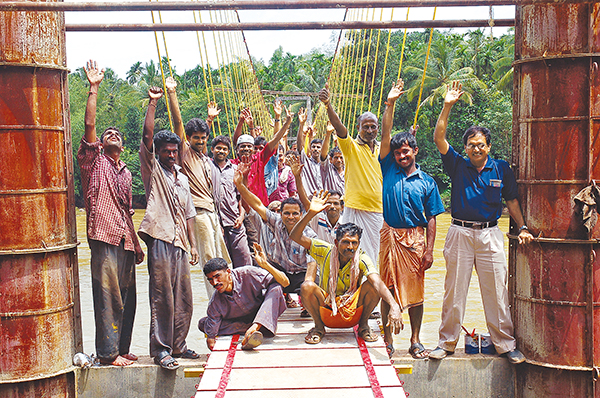
IN September, while working on a bridge near Warangal in Andhra Pradesh, Girish Bharadwaj got an unusual phone call from Mustafa,his friend in Sullia. “A foreigner has come here. He calls you his brother. Now tell me, how many brothers do you have?” he asked. It was Toni Ruttiman, 40, a Swiss who has been passionately making foot bridges for poor communities in South America, Cambodia, Laos and Vietnam. All Toni had was an address of four lines. He arrived in Sullia without informing anyone. Girish had never heard of him. But Toni knew about Girish. A friend at the Indian Embassy had read about Girish on the Internet and sent Toni a message:“Don’t think you are the only bridgebuilder. There is one more in India.” “When I first read about Girish, I wanted to meet him. Not so much because of the bridges, which are actually stronger, often of longer span and probably more durable than those we help build,” says Toni. “ But because I saw a man who, like me, had given nearly 20 years of his life to help people get across rivers, toconnect them and who does this out of a sense of duty to serve, without any profit motive. I have not been disappointed for he really turned out to be a brother in spirit and a teacher.” The two ‘brothers’ exchanged lots of stories. Toni stayed for 10 days. He saw some of Girish’s bridges and talked to local people. “Toni is really great. He has dedicated his whole life to making bridges with people’s participation,” said Girish.

Toni is not an engineer. He makes bridges using observation, experience and commonsense. “The bridge is built by peasants themselves with help from good-hearted companies, authorities and individuals. There is no name of anyone on the bridge, no logo, no profit,” says Toni who loves to invoke Mahatma Gandhi. In South America he has made 150 bridges for half a million people in Ecuador, Colombia, Costa Rica, Nicaragua, Honduras, El Salvador and Mexico.“I go find where people need a bridge. I show them pictures of bridges built by peasants. I show them myself: free, my life for the poor not employed by anyone,” says Toni. It takes him an hour to measure the proposed bridge site, make calculations and markings for excavations. The people are informed about their contribution: sand, gravel, stone, and 60 men for three days of labour to cement materials and another two days to erect the bridge.”They hear what we will give: steel pipes and steel wire ropes received from friendly companies abroad, welding, transportation and building guidance,”explains Toni.”When they all agree, they let me know. We start welding the bridge kit, they start making excavations and accumulating sand and stone.”

A date is fixed. Within three days the initial phase of bridge making is done.“Neither peasants nor us like to waste precious time,” says Toni. “In the rare case that excavations have not been made or 60 people don't care to show up, we wait two hours, then we leave, and that bridge is cancelled. The bridge kit is used on another site.” On the third visit which takes place after three to four weeks when the concrete has hardened, Toni and his men bring the cables and bridge deck elements. For the first 250 bridges, the farmers brought hard wood for the bridge deck, though these are now made of steel. In two or three days the bridge is rigged up with help from 60 villagers.“Handshakes and good wishes are exchanged and we disappear to the next place,” says Toni. He has colleagues like Walter in Ecuador and Yin Sopul and Pen Sopoan in Cambodia. “We build the bridges simultaneously, all guided through my laptop. Currently there are 18 bridges in progress and material is being transported and pre-fabricated for 140 bridges.”In 2000 Toni started building a bridge at Lempa Valley on the border between the Honduras and El Salvador to connect people separated by a river. Pieces of the prefabricated bridge had to be transported to the Honduras. Toni figured the best way to do this would be by helicopter. Although the authorities agreed, this simple request got mired in red tape and weeks passed. Finally, villagers carried the prefabricated bridge on their backs, pushing and hauling with pulleys and ropes. Since wood was scarce in the Honduras, the peasants of El Salvador contributed. The cement came from the Honduras.

It was peasants, malnourished and barefoot, who built the bridge. Finally, the bridge was ready. Hondurans and El Salvadorians were thrilled. Their ministers now turned up in full regalia for the inauguration. Just as the authorities finished their speeches and were walking to the bridge everything started swaying. An earthquake, 7.6 in magnitude on the Richter scale had struck. Toni nearly panicked. Houses came tumbling down but his people’s bridge stood strong. In 2002, Toni was invited by the Cambodian government to make bridges. He built his first bridge for them at Banan, 22 km from Battambang, Cambodia’s second largest city.“The bridge over the river Sangker serves peasants and delights thousands of visitors who come every weekend from Battambang to Banan on their motorcycles and in packed pick-ups. They even come from other provinces to stand on the bridge and have their pictures taken,” says Toni.“The peasants sell their fresh produce directly at the riverside to the people from town, along with cooked food and drinks. An entire market has developed around the bridge, and the visitors bring new income to the peasants.” Seeing this, Toni reassembled the bridge so that it could cope with the overload.”A second bridge made at Kampong Pil, 10 km upstream from Battambang, turned out to be one of our most beautiful bridges ever. The villagers are so proud of it, that afterwards they adorned the bridge with a special handrail, lighting for the night and pretty entrances with cement and carved wood.

Then they did landscaping on both riversides, and put up wooden terraces and benches for sitting and enjoying the beautiful rivers cenery with its fishing boats, the bridge, the monastery, the palms and mango trees,” says Toni. A bridge in Pailin, the last stronghold of the Khmer Rouge, saw some 50 men do the cementing work. Over 30 were crippled, or had a prosthetic. Yet they made the bridge.“It might be possible to count the many tons of goods and thousands of human beings actually crossing all our bridges in the world in one year. But how can we possibly measure the giggling of the children, the pride of the adults, the avoided suffering of the sick, or the gained knowledge of the students,” says Toni. Toni has battled infection, malaria, snakes and insects to make bridges. In Cambodia there was the constant fear of landmines. In December 2002, he was diagnosed with Guillain-Barré Syndrome (GBS) an inflammatory disorder of the peripheral nerves that paralyzes the nerves of the arms, legs, lungs, neck, and those controlling the eyes, throat and heart. He says it was his life, his experience of working with peasants and enduring long years of hardship which gave him the strength to fight the illness. Under the care of the Cambodian Prime Minister's personal physician, he was then sent to the Sirindhorn National Medical Rehabilitation Centre, a government clinic outside Bangkok, named after Thailand's Crown Princess Sirindhorn. In April 2003 he was back on his feet after an excruciating period of recovery where he exercised eight hours a day, helped by physicians at the centre. Toni has been honoured with an award by the International Association of Bridge and Structural Engineers (IABSE). Klaus Ostenfeld, president said: “Toni is not a graduated engineer, he is - as an autodidact engineer - going out directly and does what an engineer was meant to do: construct structures which can help mankind to make a better and safer life.”

e-mail: toni.ruttimann@ti-edu.ch


Want to give feedback on this article

Name
Email

Subject

Feedback
(Not more than 250 character)


Disclaimer

The views expressed here are strictly personal and civilsocietyonline.com does not necessarily subscribe to them. We shall endeavour to upload/publish as many of the comments that are submitted as possible within a reasonable span of time, but we do not guarantee that all comments that are submitted will be uploaded/published. Messages that harass, abuse or threaten other members; have obscene, unlawful, defamatory, libellous, hateful, or otherwise objectionable content; or have spam, commercial or advertising content or links are liable to be removed by the editors. We also reserve the right to edit the comments that do get published. Please do not post any private information unless you want it to be available publicly.


Top

Your Feedback on this story...
_________________________________________________________________________________________________________


About Us | Site Map | Privacy Policy | Contact Us | ©2007 Civil Society

.
........................................
Webmaster Vishwanathan ( vishu4@rediffmail.com )